
MY STORY
Leon Dogan Hung Kuen Jpourney
"I am not a big talker, and putting myself forward has never come naturally to me."
For most of my life I have been content to work quietly in the shadows — training, teaching, and serving the art and the family I represent without seeking recognition or credit for any of it. This biography is quite out of character, and it took considerable persuasion to get here. But here we are.
"What follows is an abridged story of a life dedicated to traditional martial arts — honest, direct and told as openly as I am able. It is a long read for an instructor biography, but then again it has been a long and colourful life."
"Pour yourself a tea, find a comfortable seat — or even better, sit in your horse stance (Jaat Ma) — and take your time with it. It is a true account of the journey that brought me here, and of the art that made me who I am."
"There is a version of my life that could have gone very differently."
I have had knives pulled on me, guns pointed at my face, and found myself in situations where the wrong decision — or simply bad luck — could have ended everything. I navigated all of it, and I am here doing what I do, because of martial arts. Not because training taught me to fight — I never picked up this art for that reason — but because it gave me something far more valuable and far harder to come by. It gave me character. It gave me direction. At the age when I needed a moral compass most urgently, in circumstances where many of the people around me never found theirs, martial arts gave me mine.
This is not a conventional story. It begins in a city in Turkey touched by violence, passes through the streets of East London at their most fractured, and leads eventually — through years of sacrifice, solitary searching and unrelenting commitment — to the school of one of the most respected kung fu families in the world. It is, at its core, a story about what traditional martial arts genuinely is when it is taught and received the way it was always meant to be. And it is a story I have told rarely, because I have never been someone who sought recognition for any of it.
The Evolution of Leon Dogan’s Hung Kuen Journey , Martial Arts Practice
"Flesh is yours, bone is mine."
1970's — 1980's
Turkey — Where It Began
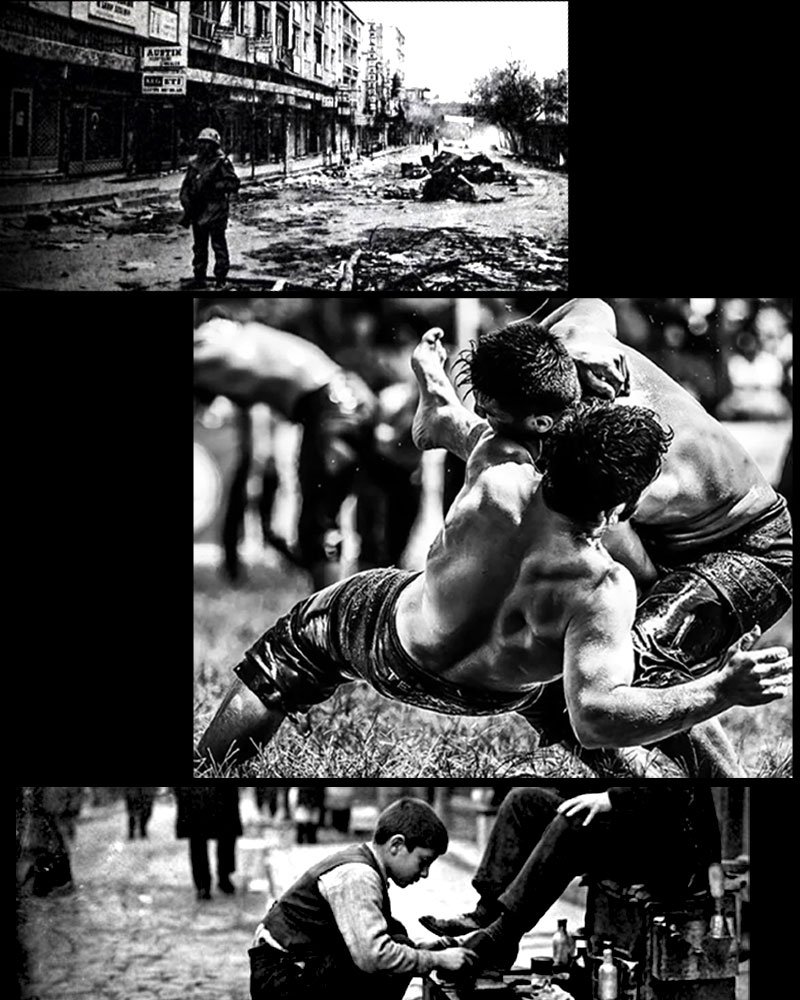
I was born into a community that knew what it meant to be a target. In December 1978, the city of my birth was shaken by days of unprovoked violence against innocent people — organised, brutal, without mercy. People died. Neighbours, friends. Families torn apart overnight. I was too young to understand it fully, but you do not need to understand violence to be shaped by it. It shapes how you see the world, how you respond to intimidation, and what you are and are not willing to accept from other people.
Something had always drawn me toward oriental martial arts — the disciplines of the East, with their combination of physical mastery, mental rigour and philosophical depth. When a Taekwondo school opened in my city in 1983 I was ten years old and knew immediately I needed to be there. My family could not afford the fees, and to that I found a solution — I woke before dawn to sell pastries for a local bakery and shined shoes after school, saving every coin toward a single goal. Impressed with their youngest son's commitment and drive to earn his own way, my parents said yes.
Before I ever stepped onto a mat, martial arts had already taught me its first lesson — that the things genuinely worth having require real sacrifice.
The day my father walked me to my first instructor he said something I have never forgotten — addressing the teacher directly: flesh is yours, bone is mine. It was a complete and sincere transfer of trust, an acknowledgement that a martial arts teacher occupied a role not unlike a second parent. Everything started with respect and carried forth with discipline. Training was demanding in ways that would be unrecognisable to most modern practitioners — classes were disciplined and brutal, pain, blood, sweat and tears an unconditional part of every lesson, with no protective equipment and no concessions to comfort whatsoever. One drill — the circle of pain — placed you in the centre of five opponents in full contact, no pads, no mercy. The discipline had purpose. The purpose was the formation of character as much as technique, and everything I absorbed about composure under pressure I have drawn on many times since.
1980's — 1990's
East London — Finding The Way
"The rules were communicated as warnings."
I was thirteen or fourteen when my family immigrated to London. Difficult years under any circumstances — the age of rapid change, of forming identity, of needing something solid to hold onto. For me the difficulty arrived in layers. A foreign country, a language I could not speak, a culture entirely different from everything I had known. We were housed in East London — Hackney, Dalston, Clapton, Stoke Newington — areas that in those years were melting pots of immigrant communities with their own tensions, hierarchies and unwritten codes. The rules were communicated to me as warnings. Don't take that bus after a certain time, don't walk through certain areas, be careful of this group, be wary of that one. Coming from a community that already knew what it meant to be a target, I understood something about being made to feel insignificant — judged as lesser because of my origin, my lack of language, my failure to fit whatever was expected of me.
What I could not do, by nature, was accept any of it quietly.
I had grown up in a culture where you faced your problems directly and without apology. You did not step aside, you did not shrink, you did not change your behaviour because someone else's prejudice demanded it of you. When I was warned not to sit on the upper deck of the bus because certain groups had claimed it, I sat on the upper deck. Not out of recklessness — but out of a simple and deeply held conviction that I had exactly the same right to occupy space as anyone else, and I was not prepared to surrender that right to anyone. That conviction cost me, repeatedly. Muggings, confrontations rooted in racial tension and cultural misunderstanding, situations that escalated quickly and had to be navigated with both physical capability and enough presence of mind not to let things go further than necessary. I had knives pulled on me. I had guns put in my face. There are moments from those years where I am genuinely uncertain how I came out intact.
Through everything, I trained. Whatever money I had went toward finding somewhere to learn. I sought out reputable schools across London — karate, kickboxing, Thai boxing, kung fu, jujitsu — training in whatever I could find and afford. And I competed consistently at my own expense, travelling as far as my budget allowed to enter open tournaments across every format — full contact, light contact, continuous sparring, kickboxing and Thai boxing. I competed not for trophies or recognition or to feed my ego — the result was never the point. I competed for experience, to test my skill under real pressure, to manage fear, control emotion, and operate outside my comfort zone in conditions with genuine consequences. Organised competition offered something the street never could — grounds for error and a controlled environment where you could test your skill without the cost of being wrong becoming irreversible. I would compete over the weekend and be back at work or school by Monday morning. I did it for the experience and the love of the challenge — long before martial arts became a career path, before fighters competed for significant money, royalties or sponsorship. It was never about any of that.
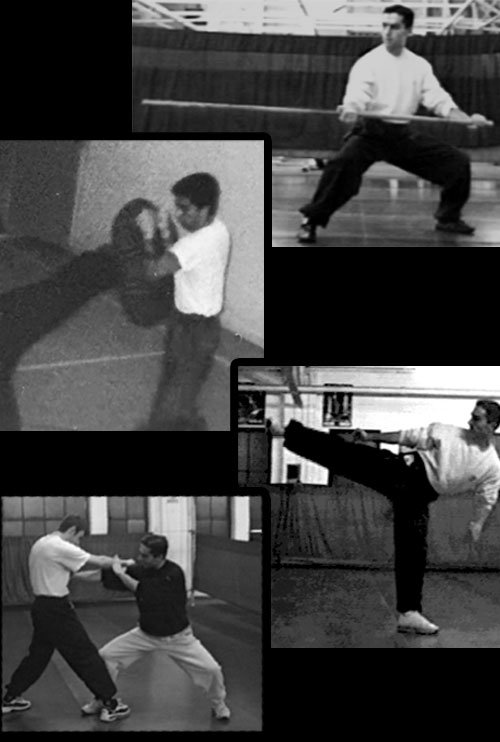
Hung Gar had found me during these London years and I fell for it completely. Something in it was categorically different — deeper in its principles, more demanding, more complete. The further I went into it, the more I understood how much I had not yet begun to understand. A teacher I respected deeply told me plainly that if I was truly serious about Hung Gar there was only one place on earth to pursue it properly. He meant the Lam family. He meant Hong Kong.
HUNGKuen.Net (-) SOUTHERN FIST
"The beginings of the internet age.."
Before I made it to Hong Kong, I had already begun doing something that almost nobody else in the martial arts world was doing. In the mid to late nineties I built one of the first websites dedicated to promoting Hung Gar online — HUNG KUEN.NET — and alongside it the Southern Fist Forum, the only dedicated online discussion community for Southern Chinese martial arts in existence at that time. The motivation came entirely from love of the art, never from any desire to promote myself or any particular lineage.
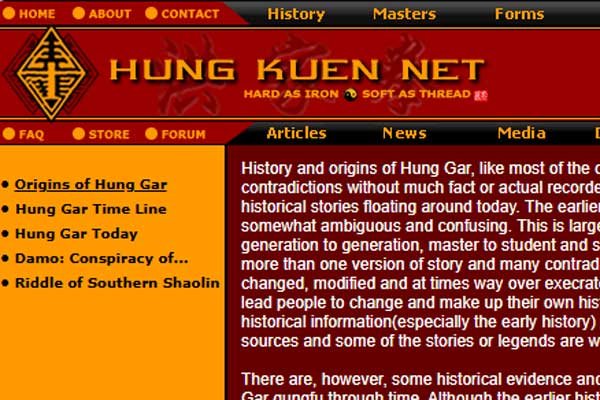
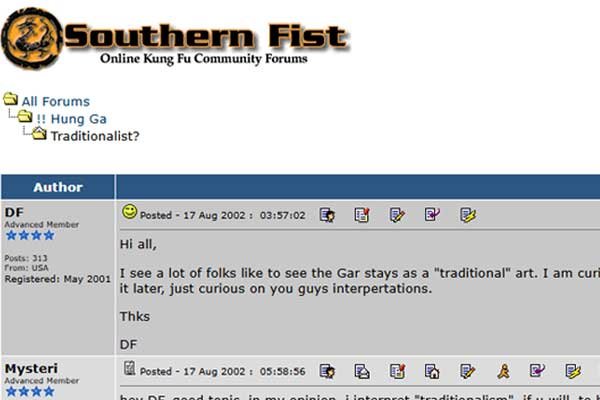
The community grew far and wide, and for a time it served its purpose well. Then the politics arrived — lineage disputes, territorial tensions, personal animosities, and in some cases direct threats. When it became clear that the space built to unite and promote had become a platform for division, I stepped back and brought it to a close. The idea had always been to promote, not to divide. When that was no longer possible, the honest thing was to walk away.
1997 — 1998
Hong Kong — The Search
"...... a needle in the haystack."
The harsh realityof actually getting myself to Hong Kong required working multiple jobs simultaneously and selling virtually everything I owned. I arrived with almost no money, no Cantonese, no contacts, and a single photograph of Grandmaster Lam Cho's school cut from a martial arts magazine. What I did not have was any idea where in a city of millions that school actually was.
What followed were weeks I will never forget. I walked the streets of Hong Kong every day — miles and miles on foot, going from school to school, unable to communicate, encountering hostility that ranged from dismissiveness to outright aggression. Racial slurs were routine. Doors were closed in my face daily. I later came to understand that I had almost certainly walked past the school hundreds of times during those weeks — it was right there, and I had no idea.
At my lowest point I came close to giving up entirely and returning to London. I had spent everything to get there and seemed no closer to what I had come for.
I kept going. Trying to find Lam Cho's school in Hong Kong seemed like looking for a needle in haystack. Finally, trough a friend I eventually made in the city, I found what I had crossed the world to find — the famous school of grandmaster Lam Cho, and the beginning of a relationship with a family that would define everything that followed.
The contrast with what I had experienced in the preceding weeks was immediate and absolute. Where I had found closed doors, the Lam family offered genuine warmth and welcome. Needles to say i was nervous but over the moon. I was accepted as a student under the personal guidance of Sifu Lam Chun Sing, and what began then has continued, in one form or another, ever since.
2000 — 2004
Hong Kong — Living It Fully
I travelled back and forth to Hong Kong repeatedly over the years that followed, each return deepening my connection to the system and to the family. Eventually the visits were not enough. I made the decision to move permanently — to live inside the art rather than simply visit it — and committed myself entirely to Hung Kuen in the place where it lived most fully.
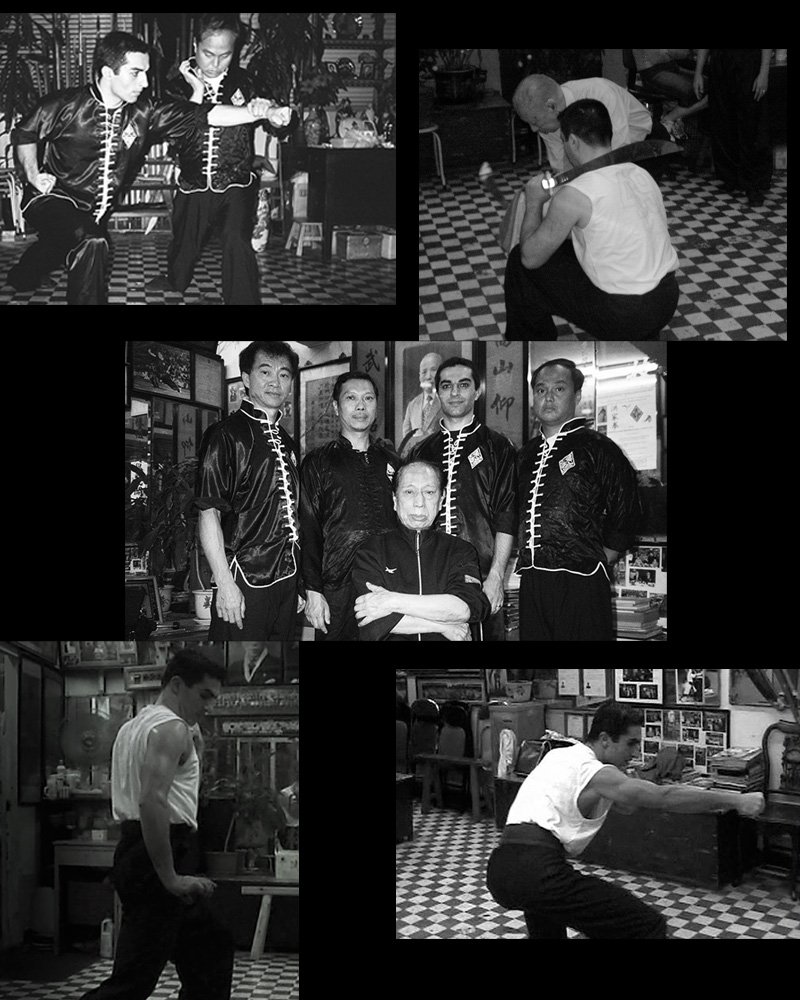
The years I spent living in Hong Kong reshaped me at a fundamental level. I trained every single day without exception. I had access to the school at hours most students never experienced, which gave me an intimacy with the material that cannot be rushed or replicated. Every member of the Lam family contributed to my understanding in their own way, and the relationships I built during those years — with my sigung and Sifu, with my Sibaks and my kung fu brothers — remain the most important of my martial arts life and among the most important of my life in any sense.
Sigung's home and school was like a living museum of Lam Family Hung Kuen history. The walls were covered with photographs dating back as far as cameras themselves — generations of practitioners, masters, family members, moments frozen in time across more than a century of the art. The tiled floors were dented and cracked from decades of training, of low stances and rooting footwork pressed into them by generation after generation of dedicated students. The walls and ceiling bore the marks of weapons practice — scraped and scored by poles and blades wielded by hands that had long since passed on. Every corner, every nook and cranny had a story to tell. The place had a character, a warmth and a weight of history that no purpose-built training facility could ever manufacture. It was, in the truest sense, a place where the art lived.
My days had a rhythm I look back on now as one of the most purposeful periods of my existence — early morning solo training in the local park, a few hours of English teaching to cover basic costs, then back to the school to train with Sifu Lam Chun Sing. Senior brothers would arrive in the evenings and we would train late into the night before heading out together for a midnight meal. It was during the quieter hours, largely through the deliberate generosity of Sije — Lam Cho's daughter, Lam Fung Chu — and her husband Wong Tong Ching, that some of my deepest learning happened. They went out of their way to create conditions for me to train and learn more fully, and I understood, even then, that this was not something extended to everyone.
The Lam family, in my experience, never advertised their selectivity — but it was present nonetheless. They welcomed everyone who came, warmly and without judgement. But genuine teaching — the kind that reveals the real depth of the system — was reserved for those who had demonstrated over time that they were truly ready to receive it. What you were given reflected precisely what you had earned. Trust and respect were not assumed. They were built slowly, through consistent commitment and honest character. For those who brought both, the family gave everything — in their own time, at the right moment, never before.
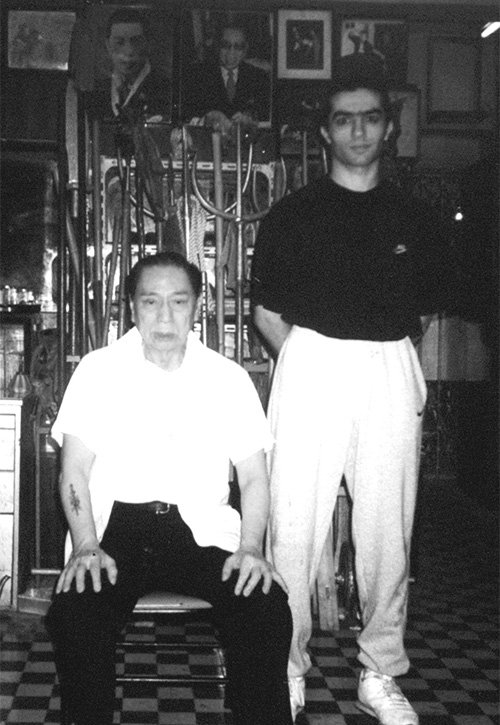
Great Grandmaster Lam Cho had officially retired by the time I arrived, but his presence defined the school regardless. He observed. He assessed. And when he saw something that required correction, he corrected it — directly, precisely, without ceremony or softening.
In my early days I would arrive to train and Sigung would sometimes appear and stand at the corner of the room, seemingly watching the television that sat on top of the fridge. I used to wonder idly why he was watching the same channel he had on in his own room. It was only gradually that I understood — he was watching my reflection in the screen. He was assessing me quietly and without my awareness, before deciding whether to commit to teaching me directly. Corrections came at first through Sije or her husband, passed on after sessions had ended. As trust developed, they came directly from Sigung himself. When Lam Cho began to teach you face to face, hands on, you understood that something fundamental had shifted.
On one of many such occasions he spent forty-five consecutive minutes correcting my Fu Hok form — his hands on me throughout, adjusting and repositioning with a grip of extraordinary power; when Lam Cho held you, you felt it in the bone — while I held a low horse stance for the entire duration, my legs long past exhaustion before we were halfway through. On another occasion he joined me in a two-person stick set, in his nineties, and I found myself struggling to keep pace with a man whose speed, precision and economy of movement seemed to belong to someone a fraction of his age. There were evenings at the chess board with a senior brother when Sigung would turn the game into a lesson in martial strategy — every move a reflection of a principle that belonged equally in the training hall. There were moments when he would emerge having watched a video of us performing at a demonstration and proceed to dismantle every one of us — calmly, precisely, exhaustively — making clear what the standard was and what it would permanently remain.
He had a name for me — Ying Gok Jai, English boy — which he used with a directness I came to understand as its own form of acknowledgment. Those who knew him called him a kung fu genius — and that was not a description arrived at lightly or loosely. It was simply a fact, recognised by everyone who had the privilege of being near him. His passing marked the end of an era — not just for our family and lineage, but for a generation and a standard of martial arts that is becoming increasingly rare in the world. I was one of his pallbearers. It was one of the most sorrowful and significant days of my life, and everything that has changed since only deepens the responsibility I feel to carry forward what he and the family gave me.
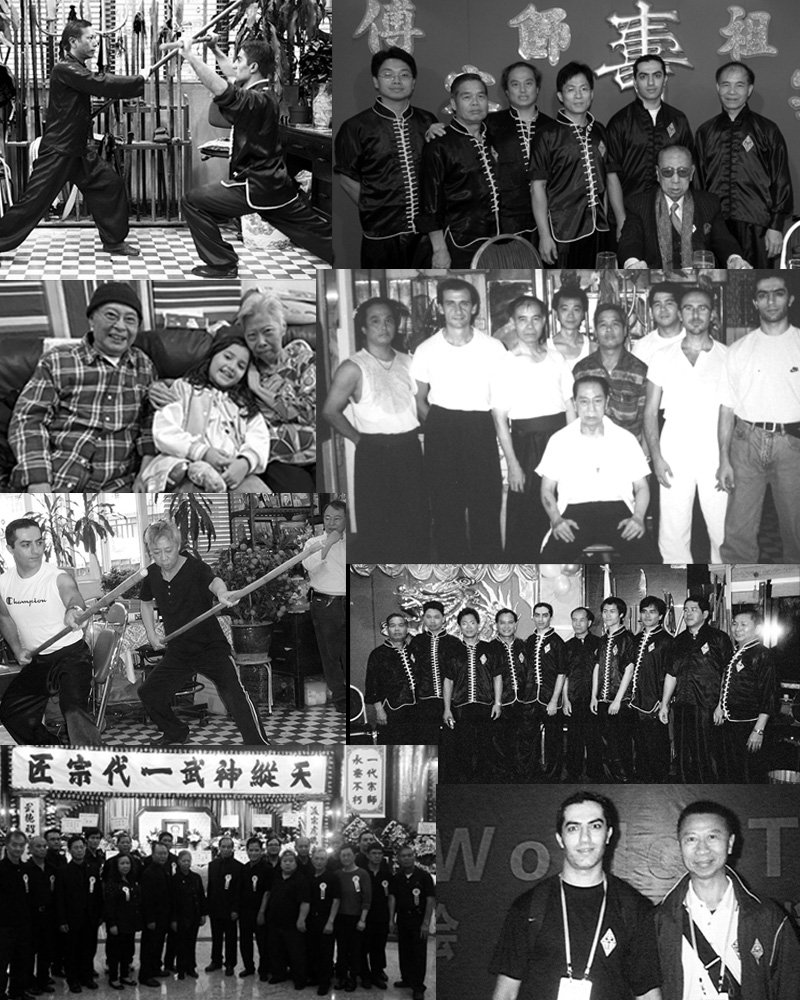
My Sifu, Lam Chun Sing, was like his father in the ways that mattered most — completely hands on, deeply demanding, insistent on perfection in everything. Lower, harder, faster, again — these were the words I heard most from him, and they are embedded in how I teach to this day. He was kind, but strict in a way that left no room for half measures, and temperamental in the way of someone who cares so deeply about the art that falling short of what it demands is genuinely difficult to witness. Training under him and his father was the central education of my martial arts life.
Sije and Wong Tong Ching guided me throughout — pulling me aside to offer direction and advice, pointing me toward what I needed to focus on, exposing me to the right things at the right times. They treated me as family then and they treat me as family now. Lam Chun Fai and Lam Chun Chung sibaks were also significant presences across those years — both offered direct guidance, advice and corrections that shaped my development, and I remain close to them and grateful to this day.
My elder kung fu brother Chung Wai Hung was beside me throughout — translating, guiding, training alongside me with the loyalty and generosity of a true brother. I would not have navigated those years the same way without him. The wider brotherhood of senior kung fu brothers became family in the truest sense. And present at the school from time to time was an older generation entirely — men who had trained under Sigung for decades, some for the better part of their lives, carrying living memory of how the art had been. Their presence was a window into a past that was otherwise inaccessible, and a reminder of the depth and continuity of what we were all part of. Their generosity in sharing their skill, wisdom and stories helped shape my path and my kung fu in ways I continue to draw on to this day.
To some visitors the school may have appeared quietly understated — a modest space where the pace seemed unhurried and the number of active practitioners small. But beneath that surface, for those who were truly present and truly ready, the tradition was as alive and immediate as it had ever been. Real kung fu was there — undiminished, there for the taking if you genuinely wanted it and were genuinely prepared to earn it.
I also put my existing skills to work for the family during these years. I built and managed websites for Lam Chun Fai and Lam Chun Sing at a time when an online presence was entirely new territory for traditional martial arts schools. The exposure these sites generated brought students from across Europe and beyond to Hong Kong to train — creating an international community around the family's teaching. Together with my brother Chung Wai Hung, we looked after visiting foreign students we slowly built an international network that would later make the European tours possible.
In 2003 I was one of the principal driving forces behind the first ever international Lam Family Hung Kuen seminar held in Hong Kong — a landmark event that brought the family's teaching to a global audience in a formal setting for the first time.
2004
Zhengzhou — The World Stage
In 2004 I travelled to Zhengzhou in mainland China as part of the Lam family delegation to compete in the 1st World Traditional Wushu Festival — organised by the International Wushu Federation and held across two dedicated stadiums. The scale was staggering: over 2,000 athletes from more than 60 countries, over 100 teams, and approximately 30,000 to 40,000 local wushu practitioners performing along a twenty kilometre highway as part of the welcoming celebrations.
It was the largest international traditional martial arts event ever held at that point — a powerful statement by the Chinese government about the value of traditional kung fu on the world stage ahead of the Beijing Olympics. The event was later renamed the World Traditional Wushu Championships and is now known as the World Kungfu Championships.
One of the ironies of this trip was that, up until that moment, I had never entered a forms competition. My passion had always lain with contact-based competition. While I had performed forms at 100s of events, gatherings, and seminars, and I deeply respected the impressive excellence of forms-focused athletes, the competitive aspect of forms had never really rocked my boat. For me, the focus was on the functional application of what I learned, rather than the "theatrics" required by the competition stage.
Nevertheless, I was there to represent. I put my focus on the forms stage, competed for the first time, and did the Lam Family Hung Kuen proud. At the end of it, after the medals were awarded, I noticed a young junior practitioner who was distraught; he had lost his medal during the event. Without thinking, I gave him mine. It felt like the right thing to do then. It still does.
Across the years I lived in Hong Kong and on many visits since, I travelled widely across mainland China — visiting the Shaolin Temple, encountering masters from styles I had only ever read about, and gaining a perspective on the breadth of Chinese martial arts that continues to inform everything I teach.
2000's
Europe And Beyond — Carrying It Outward
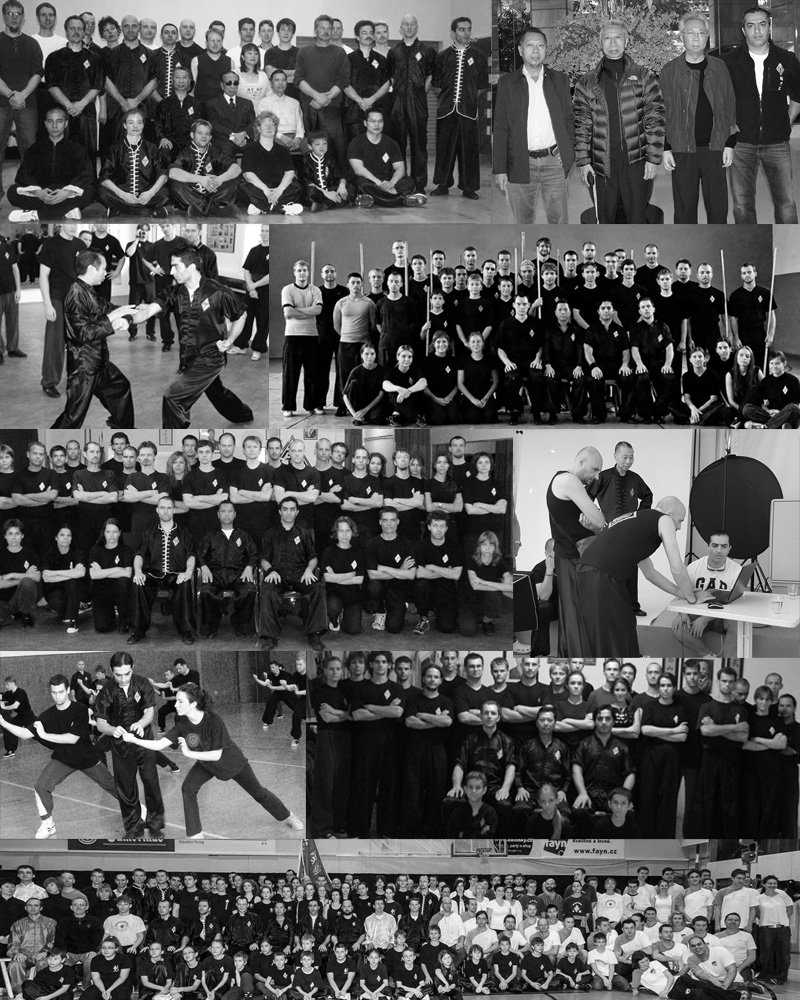
For over two decades I have organised, promoted and participated in regular teaching tours alongside my Sifu Lam Chun Sing and in support of his elder brother Lam Chun Fai — and I continue to do so to this day. We have taught across Europe — Italy, Holland, the Czech Republic, Slovakia, Greece and England — and further afield in the United States and South America, across numerous cities and over many years. I have managed logistics, handled all promotion, written articles for martial arts magazines and newsletters, and taught and demonstrated alongside my Sifu throughout.
The Czech Republic holds a particular place in this story. After decades of communism there was a hunger there for traditional martial arts unlike anything I encountered elsewhere — an openness and eagerness to absorb and understand the full depth of what was being offered. The Lam family were genuine pioneers of Hung Kuen in the Czech Republic and Slovakia, and I was part of that from the very beginning. I continue to return regularly to teach there today, and the community built across those years is one I feel a deep and lasting connection to.
I was the first person to bring Lam Chun Sing to England. He has returned many times since and continues to come. Maintaining that connection between the family and the UK has been one of the most consistent threads of my work across two decades.
During my Hong Kong years I also appeared in television interviews conducted at the school, took part in a television programme made to promote Chinese martial arts ahead of the Olympic Games, and appeared in newspapers and television news across Southern China. I contributed to two published works by Grandmaster Lam Chun Fai — Tid Sin Kuen and Hung Kuen Fundamentals — texts that serve as important references for practitioners worldwide.
And in a chapter of my story that tends to surprise people — I collaborated with Sony PlayStation on a PS2 title called Kinetic Combat. The central character was modelled on me, moved as I move, and carried my name.
None of this was done for recognition. Much of it went entirely uncredited and that was never a concern. It is part of the record, and it belongs here.
2005
London — Building The School
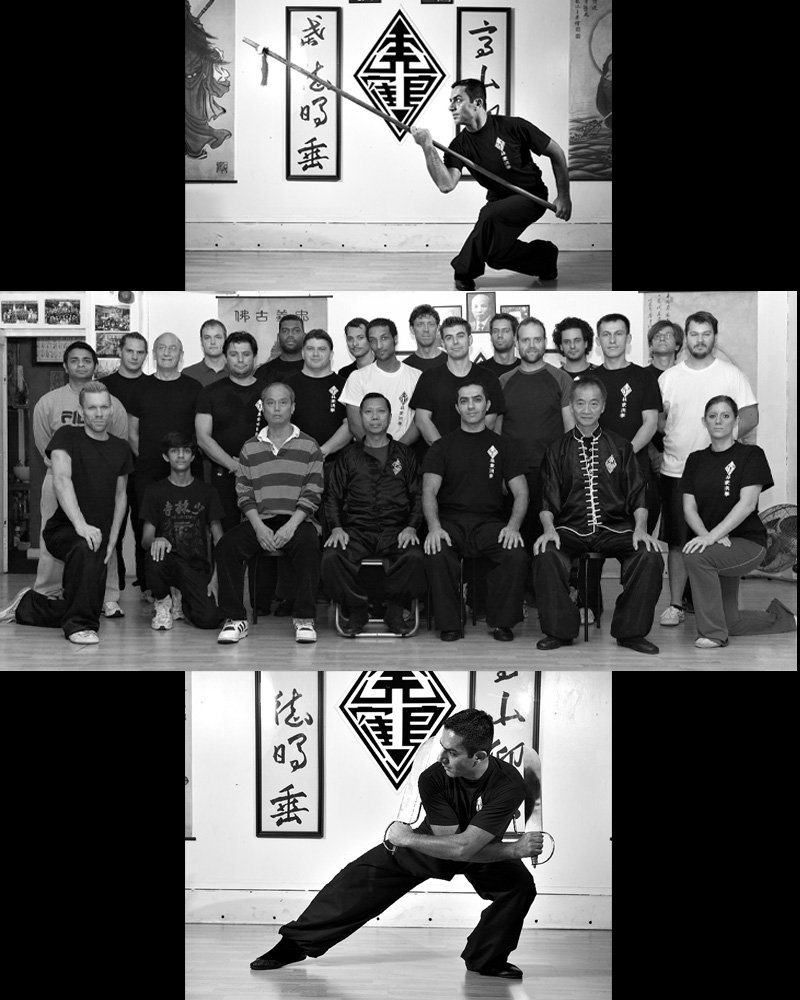
After returning from Hong Kong I began teaching privately to a small and carefully selected group, only after being actively encouraged by Lam Cho Sigung, my Sifu and my seniors. Left to my own instincts I would have continued training indefinitely — not out of any desire to withhold, but out of a genuine reluctance to present myself as a teacher before I felt fully ready. It was they who made clear that holding knowledge back was its own form of selfishness. The art existed to be passed on. I listened, as I always have, and opened the school publicly in 2007.
Building something real in London was not straightforward. It was financially brutal — for a significant period I held three jobs simultaneously to keep things running, because I had never approached the school as a business. People walked in to challenge us, to test whether there was genuine substance behind what we were offering. Some came as students but were instructors from other styles, there to evaluate or undermine. There were threats. There were death threats. I stood by what the school was and what it refused to become, through all of it.
The students who came through the doors over the years represented every walk of life — children and adults, students and professionals, military, police, private security, teachers, parents, people from every background imaginable. Martial arts, when taught with integrity, has a way of attracting people who are genuinely searching for something real. And it has a way of revealing character — in students and in instructors — that nothing else quite replicates.
Over the years I have had the privilege of meeting and training alongside some truly remarkable people — skilled, humble practitioners who embody everything martial arts should be and everything it stands for. They exist, and they are worth seeking out. But I will also say this about the martial arts world, and I say it from forty years of direct experience: the art has a complicated relationship with ego. Genuine training is supposed to tame and discipline the ego — to subordinate it to something larger than oneself, to the lineage, to the values that make the art worth practising. In practice, for many people, it does precisely the opposite. I have watched it throughout my career and I see it more acutely now, in an age where social media has confused platform with knowledge and visibility with ability. People who should not be teaching are teaching, and doing so with authority and audience. Knowledge without skill, without functional practice, without real experience — is useless. People now know everything and understand nothing. That is not a small problem. It is a fundamental corruption of what this art is and what it exists to do.
What This Is Really About
I have never taught martial arts as a fitness class or a self-defence course, though genuine training will make you both fit and capable of protecting yourself and others. What I teach is a complete traditional system — one that carries within it a philosophy of character, a set of values, and a way of approaching difficulty that extends far beyond anything that happens within the walls of a training hall.
"Martial arts gave me my life. Not as a figure of speech — literally, on more than one occasion."
And beyond survival, what it gave me was something I consider more valuable than any physical skill: the understanding that how you conduct yourself, the values you hold, the standard you set for yourself and refuse to drop below — these things matter more than almost anything else. Martial virtues were important to me on the streets of East London with a knife or a gun pointed at me. They are still important to me now. In a world that has largely traded depth for spectacle, they are becoming dangerously rare.
I teach because this art changed my life, and I have watched it change the lives of others. I teach because the Lam family trusted me with something precious and irreplaceable, and I intend to honour that trust for as long as I am able. I teach because somewhere out there are people who are looking for exactly what this is — not performance, not entertainment, not a shortcut or a certificate, but the real thing, taught with full integrity, by someone who received it directly and has dedicated their entire life to it.
There are three ingredients to becoming a good martial artist — a good teacher, a sound method, and a committed student. The first two I offer without reservation. The third is entirely down to you.
If you are serious, I would like to hear from you.
But first — I ask you — can you empty your cup and leave your ego at the door?
Sifu Leon Dogan Senior Disciple & UK Representative, Lam Family Hung Kuen