
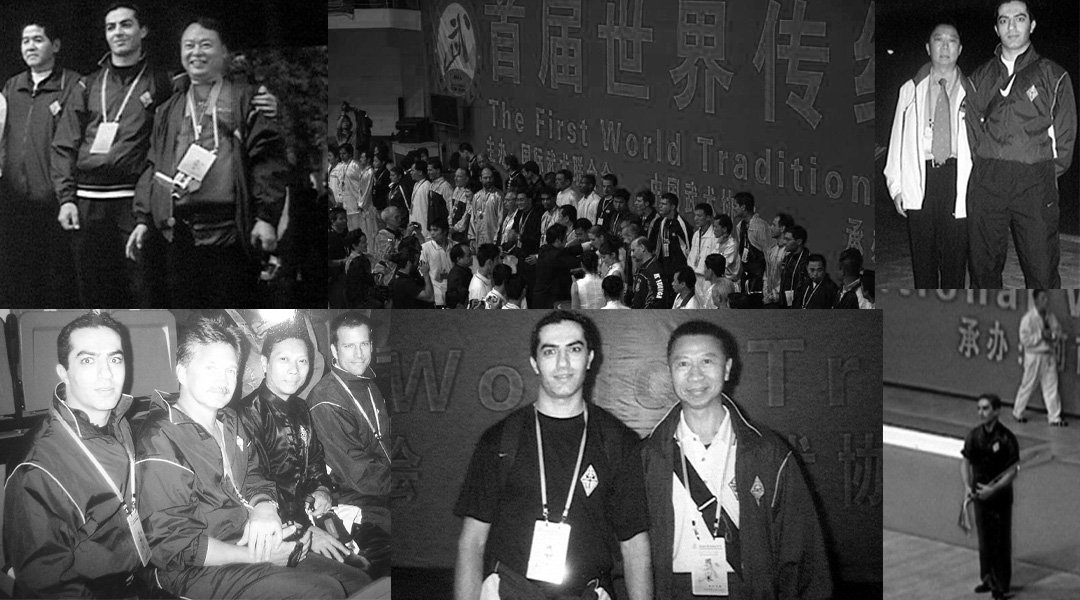
A Global Gathering in the Heart of Henan
In October 2004, the martial arts world converged on Zhengzhou, the capital of Henan Province, for the First World Traditional Wushu Festival. Sanctioned by the International Wushu Federation (IWUF), this five-day event represented one of the largest gatherings of practitioners in history, drawing over 2,500 contenders from 62 countries.
The scale of the event was unprecedented. Delegations arrived from every corner of the globe—from Azerbaijan to Zimbabwe—transforming the city into a vibrant hub of international exchange. As a practitioner attending during this era, the atmosphere in Zhengzhou was one of total civic immersion; posters, flags, and slogans lined every street, and official delegations were moved through the city under police escort, underscoring the prestige of the festival.
The Spectacular Opening at Henan Stadium
The festival commenced on October 16 with a grand opening ceremony at the Henan Stadium. Before a capacity crowd of 50,000 spectators, 153 international teams were introduced. The evening served as a high-production tribute to the martial arts, featuring fireworks and operatic performances alongside technical Wushu displays titled "Great Shaolin" and "The Soul of Wushu."
The 10-Mile Gauntlet: The Journey to Shaolin Temple
A defining highlight of the 2004 festival was the official visit to the Shaolin Temple at Songshan Mountain. The journey from Dengfeng city to the temple was marked by a "Wushu Extravaganza" that remains unmatched in scale.
Along a newly constructed 10-mile highway, an estimated 40,000 students from local martial arts schools lined the roads and hillsides. Despite cold and wet weather, these practitioners—some as young as four years old—performed continuous routines as the official buses passed. This massive display of discipline provided a visceral look at the sheer volume of practitioners within the birthplace of Chan Buddhism and Kung Fu.
[HEADING H2] Competition Dynamics: Tradition Meets Modernity
The competition was held across two primary venues: the Zhengzhou University Gymnasium and the Zhengzhou Stadium. Participants were divided into six age groups, competing in Bare-hand Routines, Apparatus (Weapons), Dual Events, and Group Events.
While modern Wushu athletes made up a significant portion of the field, the 2004 festival was a landmark for Traditional Kung Fu. It was the first official effort of this magnitude by the Chinese government to promote and preserve traditional systems.
I had the privilege of witnessing several of the most respected masters of our era representing their respective lineages, including:
- Hung Kuen: Lam Chun Fai and Lam Chun Sing (Sons of Grandmaster Lam Cho).
- Choy Lee Fut: Wong Gong, Doc Fai Wong, and Tat Mau Wong.
- Eagle Claw: Gene Lau.
- Wudang Style: Shan Gui Wen.
The Challenge of Standardized Judging
A notable point of discussion during the event was the application of the 1999 IWUF Rules for International Taolu Competition. For traditionalists, this was a complex environment, as traditional styles were often judged alongside contemporary Wushu. Despite the technical friction between traditional mechanics and modern aesthetic scoring, the event successfully brought dozens of styles—including Hung Gar, Wing Chun, Bak Mei, and Seven Star Praying Mantis—under one roof for a rigorous exchange of skill.
Conclusion: A Record of Achievement
The festival concluded with an inclusive awards system. Unlike the winner-take-all format common in Western sports, the festival utilized a percentage-based award structure (Top 20% receiving Gold), a common practice in China designed to encourage continued dedication among practitioners.
The First World Traditional Wushu Festival was more than a competition; it was a cultural milestone. For those of us in the international community, it provided a rare, high-definition look at the state of Chinese martial arts at the turn of the millennium.
Report by Leon A. Dogan. Originally written for UK Combat Magazine (2004). Published here as part of the digital archive of leondogan.com